Why Dota 2 Is Ready for a Web3 Layer
Dota 2 has always been more than a game you casually open after dinner. For many players, it is a second language, a social arena, a training ground, and sometimes a brutal mirror that shows exactly how patient, disciplined, or stubborn you really are. The game already has the ingredients that most Web3 gaming projects spend years trying to manufacture from scratch: passionate communities, high-skill competition, public performance culture, item obsession, recognizable player identity, and an esports scene that teaches even casual players to think like analysts. That is why the idea of a Web3 gaming platform for Dota 2 players feels less like a gimmick and more like a natural extension of what players already do every day. Players grind matches, unlock milestones, follow tournaments, join Discord groups, watch pro games, and chase improvement like climbers inching up a mountain in bad weather.
The opportunity for Atlas Games is not to “put Dota 2 on blockchain,” because that would be the wrong promise and, frankly, the wrong direction. Dota 2 belongs to Valve, runs through Steam, and already has its own economy, ecosystem, rules, and player expectations. A smarter approach is to build a complementary layer around player activity: a system that recognizes Steam achievements, rewards competitive participation, organizes esports tournaments, and uses TON rewards as a lightweight incentive mechanism. Think of it like a stadium district around a famous arena. The arena remains the main attraction, but restaurants, fan zones, training rooms, leaderboards, and community events make the entire experience richer.
This is where Web3 can actually become useful instead of noisy. Many blockchain gaming projects have struggled because they started with tokens first and gameplay second. Dota 2 does not have that problem. The gameplay is already deep, demanding, and emotionally sticky. A platform like Atlas Games could focus on what Web3 does best when used carefully: portable reputation, transparent rewards, programmable incentives, community ownership signals, and verifiable participation history. The key is restraint. Players do not want another complicated wallet tutorial before they queue for a match. They want recognition, competition, fair rewards, and a reason to keep playing with friends. If Atlas Games can respect that, Dota 2 players may not see Web3 as an alien layer. They may see it as a new scoreboard with real utility.
The Player Identity Problem
Every Dota 2 player has a story, but that story is often scattered across different platforms. Your Steam profile shows one slice. Your match history shows another. Your tournament results might live in a spreadsheet, a Discord announcement, a third-party bracket tool, or a forgotten screenshot posted after a late-night final. Your achievements, favorite heroes, role history, clutch tournament moments, and community reputation rarely come together in one clean identity layer. That is the player identity problem: Dota 2 players build value through time, skill, consistency, leadership, and social presence, but much of that value disappears into platform silos. It is like building a trophy cabinet where every shelf is in a different house.
A Web3 gaming platform such as Atlas Games could solve this by creating a player profile that works as a competitive passport. Not a replacement for Steam, and not a fake “ownership” claim over Dota 2 data, but a consent-based identity layer that lets players connect their Steam account, join events, complete missions, earn reputation badges, and collect TON-based rewards where appropriate. This matters because gamers already care about identity. They care about badges, ranks, skins, medals, titles, role labels, win streaks, tournament placements, and public proof that says, “I was there, and I earned this.” The difference is that Web3 can make some of these signals more portable and programmable.
Still, this has to be done with care. Player identity in Dota 2 is sensitive because people invest thousands of hours into their accounts. Any platform touching that identity must avoid suspicious login flows, unsafe scraping, fake promises, or misleading claims of official affiliation. The right model is permission-first and transparent: players choose what to connect, what to display, and whether rewards are tied to public achievements, verified tournament participation, or platform-specific missions. No one should need to expose private data just to join a weekend cup. No player should feel forced into crypto mechanics to enjoy the community.
Atlas Games could become valuable by acting like a reputation layer for effort that already exists. A support player who captains amateur teams, joins community cups, and consistently completes weekly missions should have a profile that reflects that journey. A mid player with strong tournament placements should be able to show those placements beyond one Discord server. A new player should be able to build credibility step by step, even before they reach high MMR. That is the magic: not turning identity into speculation, but turning effort into visible progress.
Why Steam Achievements Matter
Steam achievements are often treated like small pop-ups that appear in the corner of the screen and disappear as quickly as they arrived. But in a platform design sense, they are much more interesting. Achievements are structured proof that a player has completed a specific in-game milestone defined inside Steam’s ecosystem. According to Valve’s Steamworks documentation, achievements are a built-in Steam feature developers can use to define goals and track player progress through the Steam platform. For Dota 2 players, achievements can become useful signals because they represent behavior, persistence, and familiarity with different parts of the game. They are not perfect measures of skill, but they are excellent building blocks for engagement.
In Atlas Games, Steam achievements could work like the foundation stones of a wider mission system. Instead of asking players to perform random tasks that feel disconnected from Dota 2, the platform could recognize achievement milestones as proof of player history. For example, a player who has unlocked certain achievement categories could qualify for themed missions, beginner-friendly cups, role-based challenges, or loyalty badges. This creates a smoother bridge between normal gameplay and platform rewards. Players do not feel like they are abandoning Dota 2 to play a separate Web3 mini-game. They feel like their existing Dota 2 journey finally has extra layers of recognition.
The important point is that achievements should be used as context, not as the only ranking system. Dota 2 is too complex to reduce to a checklist. A player can be mechanically brilliant without chasing achievements, and another player can unlock many achievements without being tournament-ready. Atlas Games should treat achievements like a player’s travel stamps, not their entire passport. They show where someone has been, what they have tried, and how long they have engaged with the game. Combined with tournament results, seasonal missions, reputation scores, and fair-play checks, achievements can become part of a richer player profile.
This is also where SEO and user experience meet. A platform built around “Dota 2 Steam achievement rewards” or “earn TON rewards from Dota 2 tournaments” speaks directly to what players are curious about. But the product must avoid misleading language. It should not imply that Steam achievements are tokens, NFTs, or transferable assets. They are Steam-based milestones. Atlas Games can recognize them, build missions around them, and reward related participation on its own platform, but it must respect Valve’s ecosystem and player privacy. That distinction is not boring legal fine print. It is the difference between a serious gaming platform and a hype machine.
The Atlas Games Concept
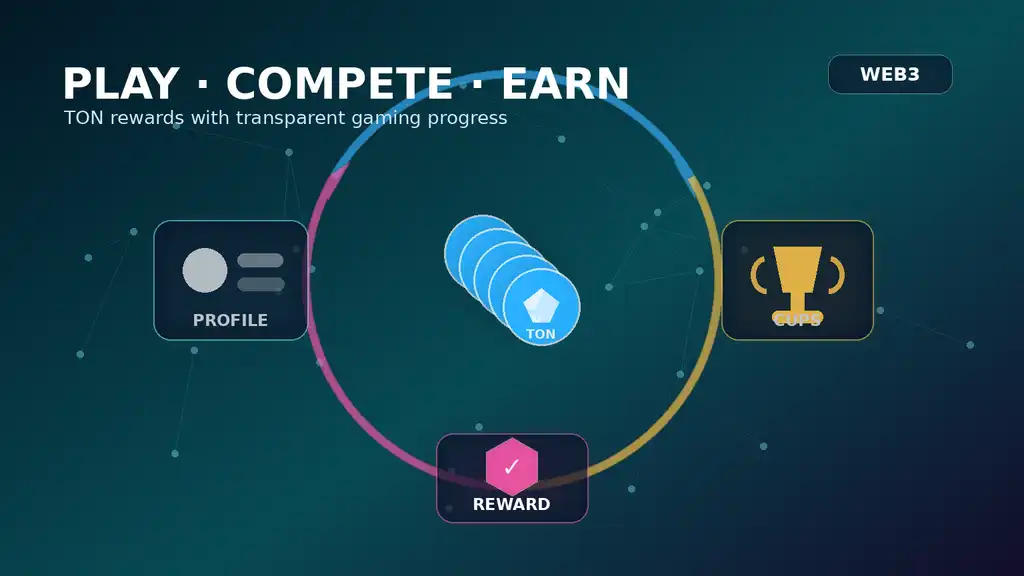
Atlas Games can be imagined as a Web3-enabled competitive hub built around Dota 2 culture rather than a separate game trying to compete with Dota 2 itself. The name “Atlas” fits because the platform’s job would be to map a player’s journey: achievements, tournaments, missions, social reputation, team history, reward claims, and seasonal progress. Most players already live across multiple spaces. They play through Steam, talk on Discord or Telegram, watch matches on streaming platforms, check brackets elsewhere, and maybe track stats through analytics tools. Atlas Games could bring those scattered pieces into one organized layer designed specifically for Dota 2 players who want more structure around competition and rewards.
The core idea is simple: connect a Steam account, verify eligible gameplay or achievement signals where permission and platform rules allow, join Dota 2 tournaments, complete community missions, and receive rewards through a TON-compatible system. But simple ideas can become messy if the design gets greedy. Atlas Games should not promise that every pub match becomes income. That kind of pitch attracts bots, farmers, and disappointed players faster than a bad draft attracts blame. A healthier model would reward meaningful participation: finishing verified tournaments, contributing to team events, reaching mission milestones, helping community organizers, or climbing seasonal ladders with fair-play protections.
This concept works because Dota 2 players understand effort-based progression. They already accept that skill improvement takes time. They know that one good match does not make you immortal and one bad match does not mean you should uninstall. A reward platform should match that rhythm. It should feel like a long campaign, not a slot machine. TON rewards can add excitement, but the deeper value is the structured community loop: players have reasons to return, teams have reasons to form, organizers have tools to run events, and sponsors have clearer ways to support grassroots competition.
Atlas Games could also serve different player types without forcing everyone into the same lane. Casual players might enjoy weekly missions based on achievements or role challenges. Competitive stacks might chase seasonal cups and prize pools. Coaches and analysts might earn reputation through guides, VOD reviews, or community contributions. Tournament organizers might receive platform tools and transparent payout flows. This variety matters because Dota 2 is not one audience. It is a crowded city: beginners, grinders, captains, theorycrafters, collectors, streamers, semi-pro players, and veterans all walking different streets under the same skyline.
A Bridge, Not a Replacement
The biggest mistake a Web3 gaming platform could make is pretending it can replace Steam, Dota 2, or Valve’s existing ecosystem. That would be like opening a lemonade stand outside a giant supermarket and claiming you are the new food supply chain. Atlas Games should position itself as a bridge, not a replacement. Steam remains the account system and game distribution platform. Dota 2 remains the actual game. Valve’s rules remain central. Atlas Games simply adds a community and reward layer around eligible player activity, tournament participation, and achievement-based missions. That humble positioning is not weakness; it is strategic maturity.
A bridge model gives players confidence because it reduces friction. They do not need to move their inventory, abandon their Steam account, or learn a brand-new game economy. They can keep playing Dota 2 as usual, then use Atlas Games to join events, track progress, and claim external rewards. This is how Web3 should enter established gaming communities: quietly, usefully, and with respect for what already works. No one wants a platform that barges into a match like a feeding offlaner and starts shouting about decentralization while the Ancient is under attack. Players want tools that make their experience better.
This bridge should also be clear about boundaries. Atlas Games should not imply that it can alter Steam achievements, modify Dota 2 match outcomes, verify private data without consent, or distribute official Dota 2 assets unless formally authorized. Instead, it can build its own reward logic around public or permissioned signals. For example, a player might connect their Steam profile, and the platform could check eligible achievements or account information permitted through Steam settings and APIs. Tournament data could be generated directly inside Atlas Games because the platform controls registration, brackets, match reporting, admin validation, and reward distribution.
The bridge metaphor also applies to Web2 and Web3 users. Many Dota 2 players may be curious about rewards but uninterested in blockchain jargon. Atlas Games should let them participate with familiar tools first: email, Steam connection, team registration, match schedules, tournament pages, and leaderboard dashboards. Wallet setup can come later, especially when a reward is ready to claim. By separating gameplay participation from immediate crypto complexity, Atlas Games lowers the emotional barrier. Players do not feel like they are walking into a finance app. They feel like they are entering a better tournament lobby.
What TON Rewards Add
TON rewards can add a powerful incentive layer when they are designed as a utility feature rather than the whole reason to play. The Open Network, commonly known as TON, is a blockchain ecosystem known for fast transactions and strong association with Telegram-native experiences, including wallets and mini-app-style user flows. For a Dota 2 community platform, this matters because gamers already gather in chat-based communities. A reward system that works smoothly inside or alongside familiar messaging environments can feel less intimidating than a heavyweight crypto dashboard full of charts, bridges, and confusing confirmations.
The appeal of TON rewards for Dota 2 players is not just that players may receive tokens. The real appeal is programmability. Rewards can be distributed automatically after tournament results are verified. Seasonal prizes can be split among team members. Community contributors can receive micro-rewards for hosting events, casting matches, moderating brackets, or writing guides. Loyalty campaigns can recognize players who show up every week. Instead of waiting days for manual payouts, players could see a transparent reward history tied to their Atlas Games profile. That kind of reliability builds trust, especially in grassroots esports where payout confusion is a common frustration.
However, TON rewards must be handled carefully because token incentives can distort player behavior. When rewards are too easy, bots arrive. When rewards are too speculative, the community turns into a marketplace instead of a gaming scene. When rewards are too complicated, normal players walk away. The best approach is to make rewards meaningful but not reckless. Prize pools should be tied to verified competition, sponsorships, platform revenue, or carefully budgeted seasonal campaigns. Small mission rewards can exist, but they should encourage healthy engagement rather than repetitive farming. The reward system should say, “Play better, participate fairly, help the community,” not “spam activity until something drops.”
TON also adds interesting possibilities for badges, non-transferable reputation markers, and claimable tournament rewards. Not everything has to be a tradable asset. In fact, some of the most valuable signals in gaming should not be bought or sold. A “Season 1 Champion” badge means more when it is earned, not purchased. A verified organizer badge should represent trust, not a price tag. Atlas Games can use TON-based tools where they improve transparency and portability, while keeping competitive reputation tied to real actions. That balance is where Web3 finally becomes practical: rewards are real, but reputation stays earned.
How Steam Achievements Can Become Progress Signals
Steam achievements can become progress signals when they are interpreted as part of a player’s broader journey rather than isolated trophies. In traditional gaming, achievements often sit quietly on a profile page. Some players chase them seriously, while others barely notice them. But in Atlas Games, achievements could become the first layer of player segmentation, mission eligibility, and personalized engagement. A platform does not need to treat every player the same. Someone with deep Dota 2 history should see different challenges from someone who just installed the game. Someone who has experimented with multiple heroes, roles, and modes may be ready for more advanced missions than someone still learning basic mechanics.
This is where achievements become useful as signals of familiarity. They help answer questions like: Has this player explored the game enough to join intermediate events? Has the player shown long-term engagement? Are there milestones that suggest they understand core systems? Again, achievements do not prove high skill. Nobody should use them as a substitute for MMR, tournament performance, or match-level analysis. But they can help shape the experience. A beginner league could require only basic account connection and platform registration. A themed challenge might require related achievements. A veteran badge could consider a combination of Steam achievements, account age, tournament history, and Atlas Games participation.
The best progress systems feel natural because they meet players where they are. Imagine logging into Atlas Games and seeing missions that reflect your actual Dota 2 life. If you have played support heroes for years, the platform could suggest captain-focused community cups or warding-themed educational events. If you have achievement history across different modes, it could recommend variety missions. If you are new, it could guide you toward beginner-friendly events without throwing you into a shark tank. This kind of personalization makes achievements feel alive instead of decorative.
There is also a strong psychological reason to use achievements well. Players love visible progress because games are built around feedback loops. A last-hit number, a rank medal, a battle pass level, a profile badge, a tournament placement—these things keep people oriented. Atlas Games can add another layer by turning achievements into readable progress markers connected to missions and rewards. Done right, the system does not cheapen Dota 2. It gives players more reasons to notice how far they have come.
Achievement-Based Missions
Achievement-based missions are the most obvious way to connect Steam progress with Atlas Games activity, but the design has to feel like Dota rather than homework. A boring mission says, “Connect account and click claim.” A better mission says, “Show your history, join a role challenge, play with a team, and prove you can contribute.” Missions should create stories. Dota 2 players remember stories: the comeback after losing all lanes, the support who saved buyback for the perfect defense, the carry who farmed like a machine for forty minutes and then died without buyback because of one greedy wave. A mission system should tap into that emotional texture.
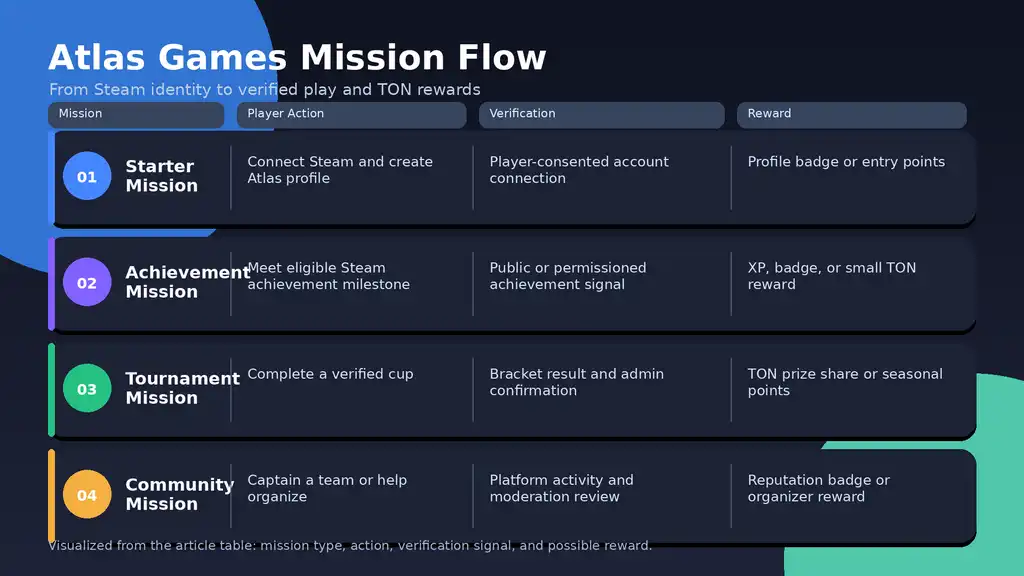
For example, Atlas Games could create weekly missions based on achievement categories, role identity, or tournament participation. A player with certain Steam achievement milestones might unlock a “Veteran Path,” while newer players might enter a “Foundation Path.” The platform could combine non-gameplay tasks, such as profile completion and team registration, with competitive tasks, such as participating in a verified community cup. Rewards would not need to depend only on winning. Showing up, finishing matches, respecting rules, and contributing to a healthy tournament environment are valuable behaviors too. Grassroots esports dies when players abandon brackets, rage quit, or ghost teammates. Rewarding reliability can be just as important as rewarding victory.
A simple mission table could help players understand how the system works:
The trick is to prevent missions from becoming shallow farming loops. Dota 2 players can smell fake engagement from a mile away. If missions reward meaningless clicks, the platform will attract the wrong crowd. If missions reward real participation, the community becomes stronger. Atlas Games should make missions feel like campfires along a long road: small moments of progress that keep players moving toward bigger competitive goals.
Anti-Abuse and Fairness
Any reward system connected to a competitive game must assume that some people will try to exploit it. That is not cynicism; it is basic game design. If Atlas Games offers TON rewards for Dota 2 activity, players will test the edges. Some may create duplicate accounts. Some may attempt bracket manipulation. Some may collude in small tournaments. Some may use smurfs to farm beginner events. Others may look for weak verification rules around achievements or match reporting. A platform that ignores abuse will quickly become a playground for farmers instead of a home for real players.
Fairness starts with identity and eligibility rules. Atlas Games does not need to invade privacy, but it does need smart guardrails. Steam account connection, minimum account history requirements for certain events, tournament check-ins, team rosters, device or behavioral risk checks, manual admin review for prize events, and cooldowns between reward claims can all help. The platform should also separate low-risk rewards from high-value rewards. A profile badge can be easy to earn. A meaningful TON prize should require stronger verification. This layered approach keeps casual participation smooth while protecting competitive payouts.
Smurfing is especially important in Dota 2 because skill gaps can ruin amateur events. Atlas Games should avoid building beginner competitions where experienced players can easily drop in and farm rewards. Eligibility can consider multiple signals: platform history, linked account data where available, previous tournament results, community reports, and admin review. No system will be perfect, but visible enforcement matters. Players are more willing to trust a platform when they see that suspicious behavior is investigated and rules are applied consistently. Fairness is not just a backend feature; it is a public feeling.
The reward economy also needs anti-abuse thinking. If players can earn tokens from repetitive low-skill tasks, bots will come. If prize pools are predictable and weakly monitored, collusion becomes tempting. Atlas Games should reward verified competition, long-term reputation, and community contribution more than raw activity volume. The goal is to make honest play the easiest path. In a good system, the player who joins real tournaments, respects opponents, and helps build the scene should naturally earn more status than the person trying to automate the edges. That is how the platform protects both its economy and its soul.
Esports Tournaments as the Competitive Engine
Esports tournaments should be the beating heart of Atlas Games because Dota 2 is at its best when the stakes are shared. Public matchmaking can be thrilling, but tournaments create a different kind of electricity. Suddenly, every smoke matters. Draft comfort matters. Communication matters. The player who is quiet in pubs becomes a shot-caller. The friend who always jokes around becomes deadly serious during Roshan fights. Dota 2 was built for those moments when five people become one nervous organism trying to outthink another team before the map collapses around them. A Web3 platform that ignores this competitive magic would miss the point.
Atlas Games can use tournaments as the strongest bridge between achievements, player identity, and TON rewards. Steam achievements and profile history can help onboard and segment players, but tournaments produce fresh, platform-native data. Who registered? Who checked in? Who played? Which team advanced? Which captain handled disputes professionally? Which players finished the season? This data belongs naturally inside Atlas Games because the platform runs the event. That makes tournament participation cleaner to verify than many external gameplay signals. It also gives the platform a direct way to reward players fairly.
The tournament layer should support different levels of seriousness. Not everyone wants to chase a semi-pro dream. Some players want a relaxed Friday night cup with friends. Others want a serious seasonal league where drafts are studied and scrims happen during the week. A healthy platform can support both. Casual tournaments keep the community warm. Competitive leagues create prestige. Sponsor-backed events bring attention. Creator cups add entertainment. Regional cups help players meet others in compatible time zones. Role-based events can make the scene feel fresh. The more formats Atlas Games supports, the more it becomes a real home instead of a one-feature website.
TON rewards fit naturally into this structure because tournaments already justify prizes. A team that wins a cup, places in a league, or completes a verified season has done something concrete. Rewards are not random; they are earned through visible competition. This also makes the platform easier to explain to skeptical players. “Play tournaments and earn rewards” is clearer than “perform vague on-chain actions for gaming yield.” Dota players appreciate clarity. They may argue about item builds for hours, but when it comes to rewards, they want the rules in plain English.
Community Cups
Community cups are the perfect entry point for Atlas Games because they are small enough to run often and meaningful enough to build habits. A community cup could be a weekend tournament for amateur stacks, a streamer-hosted bracket, a region-specific event, or a role-themed challenge. These cups do not need massive prize pools to matter. In Dota 2, bragging rights can be surprisingly powerful. A small TON reward, a profile badge, seasonal points, and public recognition may be enough to get teams excited, especially when the event is well organized and the format respects players’ time.
The secret to good community cups is reliability. Players forgive small prize pools more easily than bad administration. They want clear rules, accurate schedules, fast dispute handling, transparent brackets, and no last-minute chaos. Atlas Games could stand out by giving organizers tools that make amateur events feel professional. Automated registration, roster locks, check-ins, match result submission, admin dashboards, reward distribution, and player reputation systems can reduce the messy manual work that often burns out community organizers. When organizers are supported, players get better events. When players get better events, they return.
Steam achievements can add flavor to community cups without making them restrictive. For example, Atlas Games could host “New Blood Cups” for newer players, “Veteran Nights” for long-time accounts, or “All-Random Hero Challenge” formats tied loosely to player history and achievement variety. These themes should be fun, not gatekeeping nightmares. The goal is to create identity and story around each event. A community cup should feel like a local tournament at a favorite gaming café: familiar faces, friendly rivalries, occasional drama, and a reason to come back next week.
TON rewards can improve community cups by making payouts transparent and timely. Instead of players wondering when a prize will arrive, the platform can show reward status after admin verification. Even small prizes feel more meaningful when the process is clean. Atlas Games could also reward non-winning participation carefully, such as completion bonuses or seasonal attendance points, while keeping the largest rewards tied to performance. This protects competition while still encouraging players to show up. A great community cup should leave even eliminated teams thinking, “That was worth my evening.”
Ranked Ladders and Seasonal Leagues
Ranked ladders and seasonal leagues give Atlas Games long-term structure. Community cups create sparks, but leagues keep the fire burning. A seasonal league can run over several weeks, letting teams develop rivalries, improve strategies, and build real identity. Unlike one-day tournaments, leagues reward consistency. A team cannot simply ride one lucky draft to glory. They need communication, scheduling discipline, hero pool depth, and emotional control after losses. That makes leagues especially valuable for a Web3 gaming platform because they generate stronger proof of commitment than quick missions or single events.
A ranked ladder can sit alongside leagues as a flexible competition format. Teams or players earn points through approved matches, tournament placements, challenge queues, or scheduled matchups. Atlas Games could design ladders around regions, skill divisions, roles, or seasons. The platform might use seasonal points to qualify teams for playoffs, invitational cups, or higher reward tiers. This creates a satisfying arc: play weekly events, earn points, climb the ladder, qualify for bigger stages, and claim better rewards. It is the same emotional architecture that makes ranked modes addictive, but with community visibility and tournament stakes layered on top.
Fair division design matters here. If high-skill stacks crush casual teams every week, the ladder becomes a graveyard. Atlas Games should use placement matches, tournament history, account signals, admin review, and performance data to place teams more fairly. Promotions and relegations can keep divisions dynamic. Seasonal resets can prevent stagnation. Badges and profile history can preserve past accomplishments while still giving new teams a chance. This is where Atlas Games can learn from traditional sports: people enjoy competition more when the opponent is close enough to scare them.
TON rewards should be distributed in ways that support long-term health. Instead of giving all rewards to first place, Atlas Games could split reward pools across placements, consistency awards, sportsmanship recognition, organizer contributions, and playoff achievements. That does not mean everyone gets a trophy. It means the platform recognizes that healthy leagues require more than winners. They require teams that show up, captains who communicate, admins who solve problems, and players who respect the schedule. A seasonal league with transparent TON rewards could become one of the strongest reasons for Dota 2 players to join Atlas Games and stay there.
Designing TON Rewards for Real Players
Designing TON rewards for real players means starting with player motivation, not token mechanics. Dota 2 players are not blank spreadsheets waiting to be optimized. They are competitive, emotional, skeptical, funny, loyal, and sometimes brutally honest. If a reward system feels fake, they will mock it. If it feels unfair, they will leave. If it feels like a casino dressed as esports, they will warn their friends. Atlas Games must build rewards that feel earned, understandable, and connected to the player’s actual effort. The token layer should be the engine under the hood, not a flashing billboard blocking the windshield.
A strong TON reward system should answer four basic questions. What did the player do? How was it verified? Why is the reward amount fair? When can the player claim it? These questions sound simple, but many gaming reward systems fail because they hide the logic. Atlas Games should make reward rules visible before players join events. If a cup pays the top four teams, say so. If mission rewards require achievement verification, explain the requirement. If rewards are delayed for anti-fraud review, show that status clearly. Transparency turns rewards from mystery boxes into contracts of trust.
Real players also need reward variety. Not everyone should be pushed toward token payouts all the time. Some players want badges. Some want leaderboard status. Some want tournament entry credits. Some want team profile cosmetics inside Atlas Games. Some want access to higher-tier events. Some want TON rewards they can hold or use. A healthy system gives players multiple types of value so the community does not become purely extractive. The more reasons players have to participate beyond immediate payout, the stronger the platform becomes.
Sustainability is the hardest part. Rewards must come from somewhere: sponsorships, platform fees, premium features, partner campaigns, community-funded prize pools, or treasury allocations with strict limits. If rewards are paid without a real source of value, the system becomes a leaking bucket. Early excitement may hide the problem, but players eventually notice when incentives shrink or rules change. Atlas Games should be honest from the beginning: rewards are for verified participation, competition, and contribution, not guaranteed income. That honesty may sound less flashy, but it builds a community that lasts longer than hype.
Reward Types
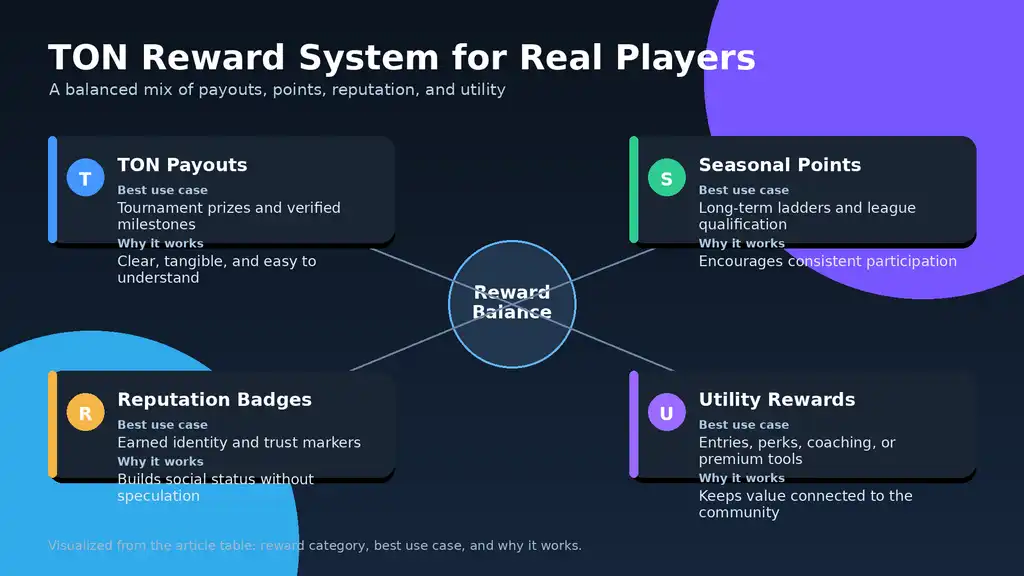
Atlas Games can use several reward types to keep players engaged without turning every action into a financial transaction. The most obvious reward is a TON token payout for tournament placements. This is clean, understandable, and tied to competitive results. A team joins a verified cup, follows the rules, wins matches, and receives a prize. Players already understand this model because esports has always used prize pools. TON simply makes the payout layer more transparent and potentially faster when implemented well.
Another reward type is platform XP or seasonal points. These are not necessarily tokens, but they matter because they shape progression. Seasonal points can qualify players for invite-only tournaments, higher divisions, special badges, or end-of-season recognition. This is important because not every valuable action deserves a token payout. If every mission pays tokens, farming becomes the main game. If some missions give reputation or progression instead, the platform can reward engagement without draining the economy. Think of XP as the road and TON rewards as the treasure chests placed at meaningful milestones.
Badges are also powerful when designed properly. A verified tournament badge, captain badge, fair-play badge, organizer badge, or seasonal finalist badge can become part of a player’s identity. Some badges should be non-transferable because their value comes from proof of achievement, not market resale. This is one area where Web3 design needs emotional intelligence. Gamers care deeply about earned status. Selling every status symbol weakens the culture. Atlas Games should protect certain reputation markers so players know they represent real effort.
There can also be utility rewards. These might include discounted tournament entries, access to coaching sessions, eligibility for special events, creator cup invitations, or team branding features. Utility rewards keep value circulating inside the platform instead of encouraging everyone to cash out immediately. A balanced reward menu could look like this:
The best reward systems feel like a well-balanced Dota draft. You need damage, control, sustain, vision, and scaling. Tokens alone are not enough. Reputation alone may not be exciting enough. Utility alone may feel too closed. Combined carefully, they create a platform economy that feels rewarding without losing its competitive heart.
Sustainable Token Economy
A sustainable token economy is the difference between a Web3 gaming platform that survives and one that burns brightly for a season before disappearing. Dota 2 players have seen enough online trends to know when something smells unstable. If Atlas Games launches with huge rewards and no clear source of funding, experienced players will ask the obvious question: where does the money come from? That question should not be avoided. It should be built into the platform’s public design. A serious reward economy needs inflows, limits, anti-abuse controls, and reasons for value to stay inside the ecosystem.
The safest model is to tie TON rewards to real platform activity and revenue sources. Tournament sponsors can fund prize pools. Premium team tools can support seasonal rewards. Entry fees, where legally and ethically appropriate, can contribute to prize structures. Partner campaigns can sponsor missions. Community organizers can create prize pools with clear rules. Atlas Games should avoid promising endless play-to-earn payouts for routine activity. That model often attracts users who are loyal to rewards rather than the game. When rewards drop, they vanish. A tournament-first model attracts players who already want to compete, with rewards acting as fuel rather than the entire vehicle.
Reward emissions should also be controlled. Not every action needs token compensation. Low-risk actions can award XP, badges, or raffle-style eligibility where rules allow. Higher-value TON rewards should be reserved for verified tournaments, seasonal achievements, trusted community contributions, and sponsor-backed campaigns. This reduces farming pressure and protects reward meaning. Scarcity does not need to feel stingy when players understand the logic. In fact, earned rewards feel better when they are not sprayed everywhere like confetti at a shopping mall opening.
The platform should also create healthy sinks and utility. Players might use rewards for tournament entry credits, team customization, coaching sessions, premium analytics, community event boosts, or creator-supported cups. These features give players reasons to keep value circulating. The goal is not to trap users, but to offer meaningful choices. A player should be able to claim a reward and feel ownership, but also see attractive ways to reinvest in their Dota 2 journey.
Sustainability is not just economics; it is reputation. If Atlas Games handles rewards responsibly, players will trust its tournaments more. Organizers will feel safer partnering with it. Sponsors will understand what they are funding. The token economy becomes a quiet support structure instead of a noisy risk. That is exactly how Web3 should work in gaming: visible when useful, invisible when unnecessary, and always tied to real player value.
Player Experience from Login to Payday
The player experience has to feel smooth from the first click. Dota 2 players may tolerate a painful learning curve inside the game because the depth is worth it, but they will not tolerate a confusing platform before they even join a tournament. Atlas Games should make onboarding feel familiar: sign up, connect Steam, create a player profile, browse events, join or create a team, check in, play matches, report results, and track rewards. The Web3 layer should appear only when it becomes relevant. In other words, do not throw wallet setup at players before they understand why the platform matters.
A good first session might look like this. A player lands on Atlas Games after seeing a “Dota 2 community cup with TON rewards” announcement. They sign in, connect their Steam account through a clear and secure flow, and see which profile data is being used. The platform recommends beginner, intermediate, or open events based on eligibility. The player joins a team or creates one. The team captain registers for a cup. After the tournament, Atlas Games verifies results and updates the reward dashboard. If the player earns a reward, the platform guides them through wallet connection or TON-compatible claim options in plain language.
This journey should avoid crypto-native assumptions. Many players do not know what gas fees, seed phrases, custodial wallets, non-custodial wallets, or transaction hashes mean. Some do not care, and that is fine. The platform should explain only what is necessary, at the moment it is necessary. For example, instead of saying “claim on-chain assets through a TON wallet,” the interface might say, “Connect a TON-compatible wallet to receive your tournament reward.” Then it can explain safety basics: never share your recovery phrase, verify links, and only use official claim pages. Simple language protects users.
The payday moment matters emotionally. When a player receives a reward after a hard tournament, it should feel satisfying, not stressful. The dashboard should show what they earned, why they earned it, whether any review is pending, and how to claim. If rewards are split across a team, the split should be visible. If a dispute delays payout, the reason should be clear. Atlas Games can win loyalty by making this process boringly reliable. In grassroots esports, reliability is rare enough to feel premium.
Onboarding without Crypto Friction
Onboarding without crypto friction means designing for Dota 2 players first and blockchain users second. The average player should be able to join Atlas Games because they love Dota, not because they already understand Web3. The platform should never make someone feel foolish for not knowing wallet terminology. A clean onboarding flow can hide unnecessary complexity while still giving advanced users the control they expect. This is a delicate balance, but it is completely achievable when product design starts with empathy.
The first step should be familiar account creation. Players can sign up with email, social login, or Steam connection depending on platform policy and technical implementation. Steam connection should be presented with clear permission language. Players need to know what is visible, what is stored, and how it will be used. Trust begins when users do not feel tricked. After account setup, Atlas Games can guide players toward profile completion, team creation, and event discovery. At this stage, there is no need to force wallet creation unless the player is entering a reward-eligible event that requires it upfront.
Wallet onboarding can be progressive. A player who only wants to browse tournaments should not need a wallet. A player joining a free community event might not need one until rewards are involved. A player who wins a TON prize can receive a guided claim process after verification. This reduces drop-off because the wallet has context. Instead of being an abstract chore, it becomes the key to receiving something earned. The difference is huge. People hate paperwork before value is clear; they accept setup when the benefit is obvious.
Security education should be built into onboarding without becoming a lecture. Short reminders near wallet actions are more effective than giant warning pages. Atlas Games can say things like: “Never share your recovery phrase,” “Use only official Atlas Games links,” and “Admins will never ask for your private keys.” These messages are simple, but they prevent real harm. Since gaming communities are frequent targets for phishing, reward platforms must treat safety as part of user experience.
A frictionless platform feels like a good support player: always present, rarely dramatic, and quietly saving you from disaster. If Atlas Games can help users move from Steam achievements to tournaments to TON rewards without confusion, it will do something many Web3 gaming projects failed to do. It will make blockchain feel optional, useful, and human.
Safety, Compliance, and Trust
Safety, compliance, and trust are not decorative features for Atlas Games; they are the pillars holding the entire structure up. Any platform connecting Dota 2 activity, Steam identity, esports tournaments, and token rewards must be extremely careful about rules, user protection, and communication. It should never imply official partnership with Valve, Steam, Dota 2, Telegram, or TON unless such a partnership exists and is publicly verified. It should clearly explain that Dota 2 is owned and operated by Valve and that Atlas Games is an external platform building community features around permitted signals and independently organized events.
Compliance becomes especially important when rewards have value. Depending on region, prize tournaments, token distributions, entry fees, and promotional campaigns may trigger legal requirements. Atlas Games should design flexible regional rules, age restrictions where needed, tax notices where appropriate, and clear terms for reward eligibility. This may sound dull compared with clutch Aegis steals, but it protects the platform and the players. Nothing kills community trust faster than rewards being frozen, events being canceled, or rules changing after players have already competed.
Trust also depends on data handling. Players should know what data is collected from Steam-connected accounts, how tournament data is stored, and whether public profiles can be hidden or customized. Privacy settings matter because not every player wants their full gaming history displayed. Atlas Games should let users control profile visibility, disconnect accounts, and understand reward-related recordkeeping. A platform that respects privacy feels professional. A platform that grabs everything it can feels desperate.
Dispute resolution is another trust layer. Dota 2 tournaments can produce arguments about lobby settings, stand-ins, server issues, pauses, disconnects, smurfing, cheating accusations, and match reporting. Atlas Games needs written rules and trained admins. Reward payouts should wait for verification in higher-stakes events, and the dashboard should show review status. Players may not love delays, but they will accept them if the process is transparent and consistent.
The final piece is communication. Atlas Games should speak plainly, avoid exaggerated earning claims, and publish clear documentation. It should cite relevant platform policies, explain reward mechanics, and announce changes before they affect players. Trust is built like MMR: slowly, painfully, and through repeated performance. One good launch is not enough. Atlas Games has to keep showing the community that it values fair play over hype.
Conclusion
A Web3 gaming platform for Dota 2 players works best when it respects what already makes Dota 2 great. The game does not need a blockchain costume. It needs better community infrastructure, stronger tournament tools, more visible player identity, and reward systems that recognize real participation. Atlas Games can become valuable by connecting Steam achievements, esports tournaments, and TON rewards into one thoughtful layer. Steam achievements provide early progress signals. Tournaments create verified competitive moments. TON rewards add transparent incentives. Together, they can form a loop that feels natural: play, prove, compete, earn, improve, and return.
The winning formula is not “play-to-earn” in the shallow sense. It is compete-to-progress, participate-to-build, and earn-when-value-is-created. That distinction matters. Dota 2 players are not looking for a platform that turns every match into a chore. They want meaningful events, fair brackets, real recognition, and rewards that do not damage the culture of competition. Atlas Games should focus on community cups, seasonal leagues, achievement-based missions, transparent prize pools, and reputation systems that cannot simply be bought. It should make Web3 feel like a useful toolkit, not a personality test.
The most important design principle is restraint. Connect to Steam carefully. Use achievements respectfully. Run tournaments professionally. Distribute TON rewards transparently. Protect users from scams. Avoid inflated promises. Make onboarding simple enough for non-crypto players and robust enough for experienced users. If Atlas Games can do that, it has a real chance to become a trusted hub for Dota 2 communities that want more than ordinary matchmaking.
Dota 2 is a game of timing. Push too early and you feed. Wait too long and you lose the map. Web3 gaming has made both mistakes in the past. Atlas Games has a better path available: enter quietly, add real utility, reward real players, and let the community decide its value through repeated use. That is how Steam achievements, esports tournaments, and TON rewards can work together—not as hype stacked on hype, but as a practical system built around the people who keep Dota 2 alive match after match.
FAQs After the Conclusion
1. Can Atlas Games officially connect with Dota 2 and Steam achievements?
Atlas Games would need to work within Steam’s available tools, public data rules, user permissions, and Valve’s policies. It should not claim official integration unless a formal partnership exists. A responsible model would use player-consented account connection and eligible public or permissioned signals.
2. Are TON rewards the same as earning money from every Dota 2 match?
No. A sustainable platform should not promise rewards for every normal match. TON rewards make more sense for verified tournaments, seasonal milestones, sponsored campaigns, and meaningful community contributions.
3. Can Steam achievements prove a player is skilled at Dota 2?
Steam achievements can show progress, history, or familiarity, but they do not fully prove skill. Atlas Games should combine achievements with tournament results, seasonal performance, fair-play checks, and community reputation.
4. How can Atlas Games stop bots, smurfs, and reward farmers?
It can use layered protections such as Steam account checks, tournament verification, roster rules, admin review, cooldowns, risk scoring, and stronger verification for higher-value rewards. No system is perfect, but visible enforcement helps protect trust.
5. Why use TON rewards instead of regular prize payouts?
TON rewards can offer transparent, programmable, and potentially faster distribution for eligible events. They also work well with digital community experiences, but they should be introduced carefully so normal Dota 2 players do not face unnecessary crypto friction.