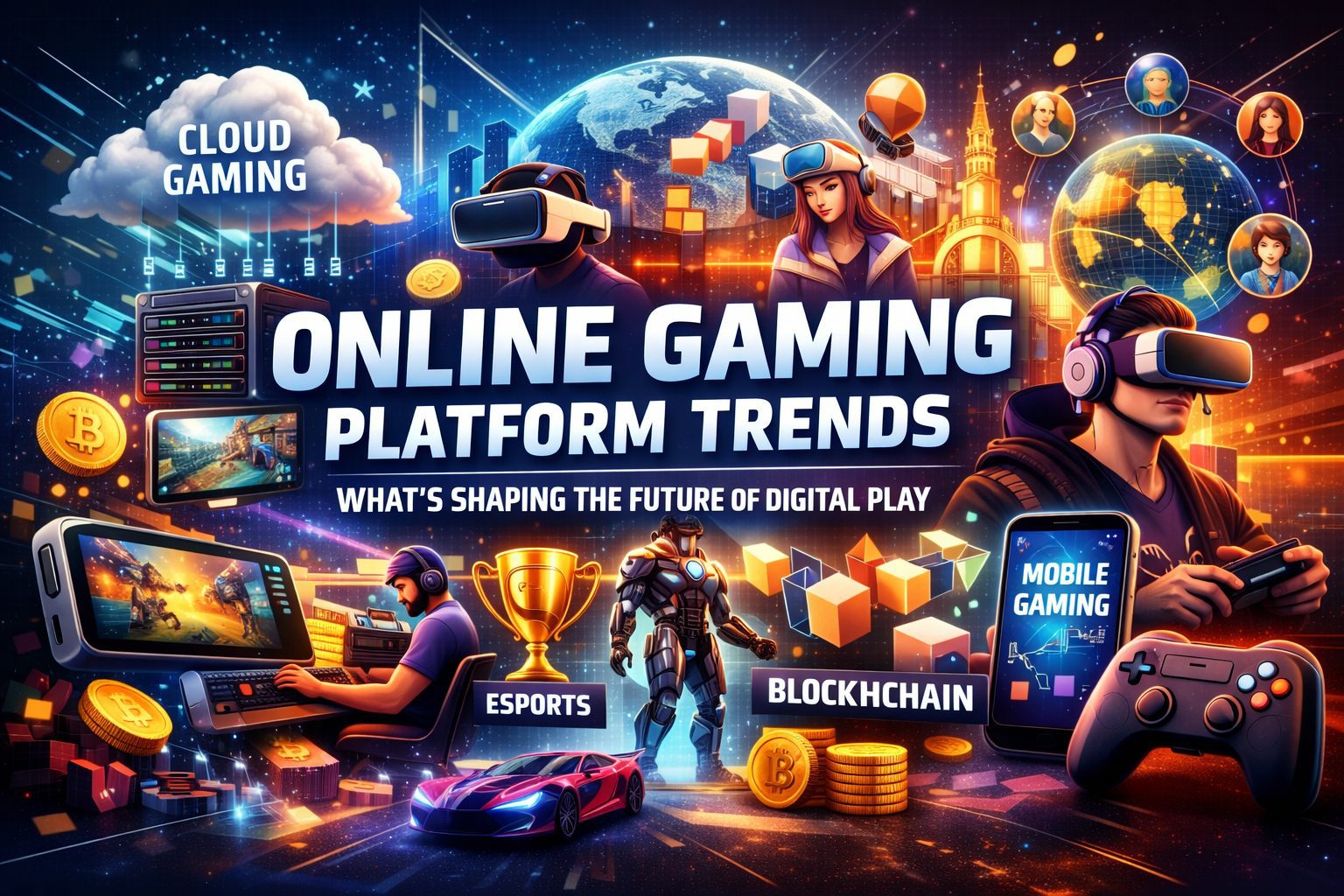
Introduction to Online Gaming Platform Trends
Online gaming platforms are no longer just places to play games. They’re living, breathing digital worlds where people compete, socialize, earn, and even build careers. If you think of early gaming as a single-player arcade machine, today’s platforms are more like bustling digital cities.
So what’s driving this transformation? Technology, player expectations, and global connectivity are pushing gaming platforms to evolve faster than ever.
Why gaming platforms matter more than ever
Gamers today don’t just want games. They want seamless access, fair competition, social interaction, and personalization. Platforms sit at the center of all that, acting as the glue that holds games, players, and communities together.
From simple games to digital ecosystems
Modern platforms integrate wallets, chats, rankings, AI systems, content creation tools, and even marketplaces. Gaming has become an ecosystem, not a product.
The Evolution of Online Gaming Platforms
Early browser-based and PC gaming platforms
Back in the day, online gaming meant simple multiplayer lobbies and basic servers. Performance issues, cheating, and limited scalability were common headaches.
The rise of console networks and mobile gaming
Console networks introduced friend lists, achievements, and digital stores. Mobile platforms then took accessibility to another level, putting games in everyone’s pocket.
How cloud infrastructure changed everything
Cloud computing removed many technical barriers. Platforms can now scale instantly, handle millions of users, and roll out updates globally without friction.
Cloud Gaming Becomes Mainstream
What cloud gaming really means
Cloud gaming allows players to stream games instead of downloading them. The heavy processing happens on remote servers, not on your device.
Benefits for players and platforms
Players enjoy instant access and lower hardware costs. Platforms benefit from better control, reduced piracy, and broader reach.
Challenges still holding cloud gaming back
Latency, internet reliability, and data costs remain obstacles. But with faster networks rolling out worldwide, these gaps are closing fast.
Cross-Platform Play as a New Standard
Why gamers demand cross-play
Nobody wants to abandon friends just because they use different devices. Cross-platform play solves that problem.
Social gaming without hardware barriers
Whether you’re on a console, PC, or mobile, modern platforms aim to bring everyone into the same game world.
Business impact on gaming platforms
Cross-play increases user retention, engagement, and lifetime value. It’s no longer a “nice-to-have”—it’s expected.
Artificial Intelligence in Online Gaming Platforms
Smarter matchmaking and personalization
AI helps platforms match players with similar skill levels, reducing frustration and improving fairness.
AI-powered moderation and safety
From detecting toxic behavior to flagging cheating, AI keeps gaming environments cleaner and safer.
Adaptive difficulty and player engagement
Some platforms now adjust difficulty in real time, keeping players challenged but not overwhelmed. It’s like having a game that reads your mind.
Blockchain and Web3 Gaming Platforms
Ownership of in-game assets
Blockchain enables true ownership of digital items, allowing players to trade or sell assets outside the game.
Play-to-earn and digital economies
Gaming is no longer just entertainment—it can be income. Platforms experimenting with tokenized rewards are reshaping player motivation.
Risks and sustainability concerns
Volatility, regulation, and speculative behavior pose real challenges. Long-term success depends on balanced design, not hype.
Real-Money and Competitive Gaming Growth
Skill-based gaming and esports convergence
Competitive platforms blur the line between casual play and professional esports, attracting serious players.
Secure payments and compliance
Trust is critical. Platforms must handle payments, withdrawals, and identity verification flawlessly.
Trust as a platform differentiator
Players stick with platforms that feel fair, transparent, and reliable.
Mobile-First Gaming Platforms
Why mobile dominates global gaming
Mobile devices are everywhere. For many users, mobile is their only gaming option.
Lightweight platforms and instant play
Instant games with no downloads reduce friction and boost engagement.
Monetization strategies on mobile
Ads, microtransactions, and subscriptions dominate—but balance is key to avoid player fatigue.
Social and Community-Driven Gaming
Gaming as a social network
Friends lists, clans, and in-game chat turn platforms into social hubs.
Streaming, chat, and shared experiences
Watching, chatting, and playing together are now inseparable experiences.
Community retention strategies
Events, rewards, and user-generated content keep communities alive and loyal.
Immersive Technologies: AR and VR
Virtual worlds and persistent environments
Immersive platforms aim to create worlds that never sleep.
Hardware limitations vs future potential
Devices are improving, but mass adoption will take time.
Metaverse-inspired gaming platforms
Gaming platforms are laying the groundwork for persistent digital universes.
Subscription Models and Platform Monetization
From one-time purchases to recurring revenue
Subscriptions provide stability for platforms and value for players.
Value perception among players
Gamers want flexibility, not forced bundles.
Bundling content and services
Platforms increasingly combine games, perks, and cloud access into single plans.
Security, Privacy, and Fair Play
Anti-cheat systems and fraud detection
Advanced detection systems protect competitive integrity.
Data privacy and user trust
Transparent data policies are no longer optional.
Regulatory pressure worldwide
Compliance with regional laws shapes platform design.
Regional Trends in Online Gaming Platforms
Asia-Pacific dominance
Massive player bases and mobile-first cultures drive innovation.
Emerging markets and growth opportunities
Affordable devices and better connectivity fuel rapid adoption.
Localization and cultural adaptation
Language, payment methods, and content localization are critical.
The Role of Analytics and Big Data
Understanding player behavior
Data reveals what players love—and what makes them quit.
Data-driven platform optimization
From UI design to pricing, analytics guide decisions.
Ethical use of gaming data
Platforms must balance insight with respect for user privacy.
Future Outlook for Online Gaming Platforms
What the next 5 years may look like
Expect more convergence: gaming, social media, finance, and entertainment blending together.
Platforms as entertainment super-apps
The future platform won’t just host games—it’ll host experiences.
| Trend | What It Means | Impact on Players | Impact on Platforms |
|---|---|---|---|
| Cloud Gaming | Games are streamed from remote servers instead of being downloaded | Instant access, no high-end hardware needed | Wider audience reach, reduced piracy |
| Cross-Platform Play | Players on PC, console, and mobile can play together | More social connectivity, no device barriers | Higher user retention and engagement |
| Artificial Intelligence (AI) | AI-driven matchmaking, moderation, and personalization | Fairer matches, safer communities | Better player experience and automation |
| Blockchain & Web3 | Tokenized assets and decentralized ownership | True ownership of in-game items | New revenue models and digital economies |
| Real-Money Gaming | Skill-based competitions with cash rewards | Competitive gameplay with earning potential | Increased compliance and trust requirements |
| Mobile-First Platforms | Platforms optimized primarily for smartphones | Gaming anywhere, anytime | Massive scalability and global reach |
| Social & Community Features | Chat, clans, streaming, and shared gameplay | Stronger social bonds | Higher lifetime user value |
| AR & VR Gaming | Immersive and interactive virtual environments | Deeper engagement and realism | Differentiation through innovation |
| Subscription Models | Monthly access to games and platform services | Better value and flexibility | Predictable recurring revenue |
| Data & Analytics | Behavioral and performance data analysis | More personalized experiences | Smarter decision-making and optimization |
Conclusion
Online gaming platform trends show one clear direction: platforms are becoming smarter, more social, and more immersive. Technology like AI, cloud computing, and blockchain is reshaping how we play, connect, and compete. The platforms that win the future will be the ones that balance innovation with trust, fun with fairness, and growth with sustainability.
FAQs
1. What is the biggest trend in online gaming platforms right now?
Cloud gaming and cross-platform play are currently leading the transformation.
2. Are online gaming platforms moving toward real-money gaming?
Yes, especially skill-based and competitive formats with strong compliance systems.
3. How does AI improve gaming platforms?
AI enhances matchmaking, personalization, moderation, and overall user experience.
4. Will blockchain gaming replace traditional platforms?
Not entirely, but it will coexist and influence ownership and digital economies.
5. Why are mobile gaming platforms growing so fast?
Accessibility, affordability, and global smartphone adoption drive mobile dominance.